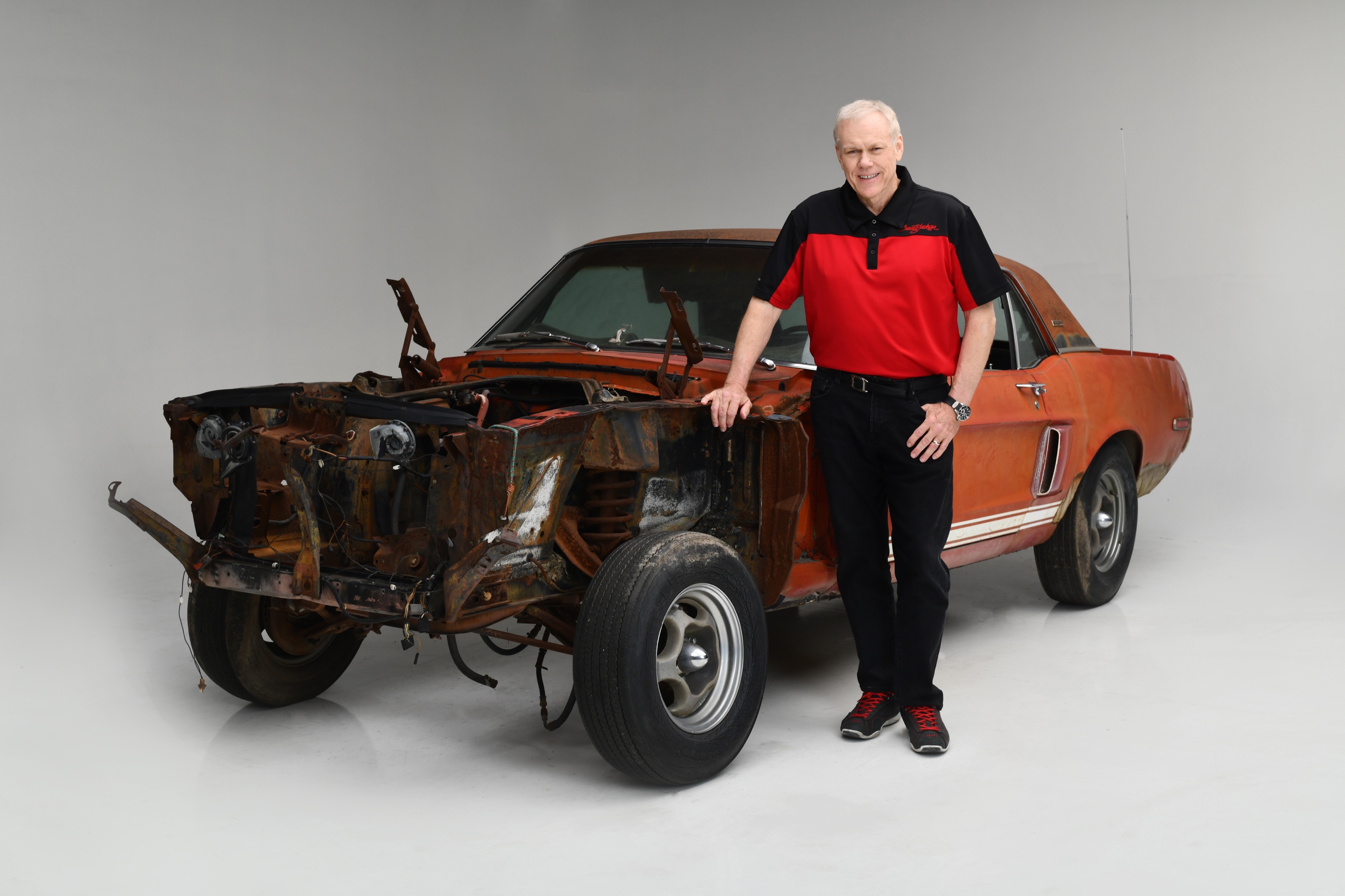
Behind "Little Red", Carroll Shelby's Experimental 1967 Ford Mustang Shelby GT500
While many rare Shelby Mustangs have been created through the years, the 1967 Shelby GT500 EXP Prototype Coupe nicknamed “Little Red,” is truly a standout. And best of all, there was only one ever built.
The Origins of "Little Red"
In August 1966, only a few months after beating Ferrari at Le Mans, the San Jose Ford production plant received a request from Shelby American for three Mustangs — a convertible, a fastback, and a coupe. Carroll Shelby and his team were embarking on a mission to create new production prototypes for the Shelby Mustang. The vision was to create a car that married Ford’s powerful engine and engineering with Shelby’s dream of street-legal, track-ready performance.
Ford & Shelby: Collaboration Magic
Carroll Shelby’s collaboration with Ford throughout his career has always led to the creation of iconic models whose legacies speak for themselves. Though Little Red was a prototype, it served as the catalyst for the genius innovations the two powerhouses would go on to create. The Shelby American team, as well as Ford designers such as Chuck McHose and Pete Stacy, worked hand in hand to conceptualize the new direction for the Ford Mustang. A byproduct of these collaborations was the lasting influence their engineering and designs had on the automotive industry.
Engineering and Features of "Little Red"
Little Red, the only notchback coupe ever built by Shelby, was a beast of a prototype.
From Mustang Coupe to Little Red
The Shelby American team, overseen by Chief Engineer Fred Goodell, created Little Red in 1967. This one-of-a-kind model featured an impressive and experimental design and build. It included:
- V8 428 Police Interceptor engine with a medium-riser 2x4 intake, a Holley four-barrel 715-cfm carbs, and twin Paxton superchargers
- Cobra Hi-Rise manifolds
- Cast-aluminum valve covers and oil sumps
- Expanded radiators
- Tubular Tri-Y exhaust headers with short side pipes
- Four-speed, Borg-Warner T10 all-synchro transmissions
- Koni adjustable shocks
- Ford Galaxie rear axles
- Kelsey-Hayes front disc brakes
- 15-inch Kelsey-Hayes wheels
- Fiberglass hood
- Deluxe black interior
- Air conditioning
- Tinted glass
- Ford “Calypso Coral” red paint
- Black vinyl top featuring GT500 emblems and trim
- 1967 grille
Little Red boasted so much power from the supercharged V8 that the original C-6 tail housing broke during testing and had to be replaced with cast-iron Lincoln tail housing. The use of a 428 engine with a single four-barrel and twin Paxton superchargers was a groundbreaking feature for the era, showcasing Shelby’s commitment to pushing boundaries and innovative design.
Fred Goodell notably said that Little Red could “Outpace the fastest Firebird in Venice.”
Rediscovery and Restoration
Most prototype cars are eventually crushed, and Little Red was slated for that same fate. Since there were no records of the car actually being destroyed, its survival became somewhat of an urban legend in the automotive world. Car collectors and Mustang enthusiasts would try to hunt down the prototype over the next 50 years with no luck. 
Dare to Discover
In 2018, Jason Billups, owner of Billups Classic Cars and Auto Body, was restoring Craig Jackon’s, CEO of Barrett-Jackson Auctions, “Green Hornet” — a famous 1967 Shelby GT500 prototype. As the topic of Little Red came up, Craig Jackson dared Billups to find it.
They teamed up and found the long-lost prototype. Little Red had been parked in a field in North Texas for more than 20 years. It was the type of discovery that collectors, restorers, and enthusiasts dream about.
Restoring a Legend
Little Red sat in a rural field in the heart of Tornado Alley for twenty years and inevitably led to a lot of deterioration. When Jackson bought the car, it had a collapsed suspension, rusted bodywork, a missing front end and hood, and a missing engine.
Jason Billups and Craig Jackson began their restoration, reviving Little Red to its former glory. The process took two years. The restoration team worked off Shelby’s original schematics as well as the recollections of several members of the original 1967 build and test team.
The restoration, which stayed true to Little Red’s prior specs, included:
- Twin Paxton superchargers
- “Beefed up” transmission
- Cast-iron Lincoln tail-housing
- 9” rear with 4.30:1 gears
- Vented hood
- Outboard grille lights
- GT350R racing-type lap belts
- That iconic candy apple red paint
Documenting the Dream
The search, discovery, and restoration of Little Red has been immortalized in a documentary by Barrett-Jackson entitled The World’s Greatest Collector Car Auctions, which premiered in 2021. The documentary is narrated by Carroll Shelby’s grandson, Aaron Shelby.
“Every collector and historian dreams of making such an incredible find. We rewrote history throughout this process of locating, purchasing, and restoring “Little Red,” a car long believed lost.” — Craig Jackson
Legacy of "Little Red"
Little Red was created to help mold the future of Shelby Mustang models. Were it not for this model, we might not have the iconic cars Shelby and Ford went on to create together. What was once considered to some as the holy grail of collector cars and, to others, an urban myth, Little Red’s journey is one befitting the Shelby legacy; innovation never dies.
Finding Little Red was like trying to find a needle in a haystack. It was the type of adventure collectors yearn for. Restoring the once-forgotten Shelby prototype to its full splendor was a labor of love and a chance to document automotive history. Staying true to the original schematics was also a way to honor the late Carroll Shelby’s innovative vision and spirit.
|

